Technology is transforming the way we live and work. Among the most revolutionary technologies shaping our future are the Internet of Things (IoT) and Automation. From smart homes that control lights automatically to industrial systems that manage entire production lines with minimal human intervention, IoT and automation are becoming an essential part of modern life.
Businesses use these technologies to increase efficiency, reduce costs, and improve decision-making. Individuals benefit from smarter homes, connected devices, and enhanced convenience. As technology continues to advance, understanding IoT and automation has become increasingly important for students, engineers, and technology enthusiasts.
In this article, we will explore the exciting world of IoT and automation, understand how they work, examine their applications, and discover why they are shaping the future of industries worldwide.
What is IoT?
The Internet of Things (IoT) refers to a network of physical devices connected to the internet that can collect, exchange, and process data.
These devices use sensors, microcontrollers, communication modules, and cloud platforms to interact with users and other devices.
Examples of IoT devices include:
- Smart thermostats
- Smart lighting systems
- Smart watches
- GPS trackers
- Smart energy meters
- Industrial sensors
- ESP32-based monitoring systems
The primary goal of IoT is to provide real-time information and remote control capabilities.
Simple Example
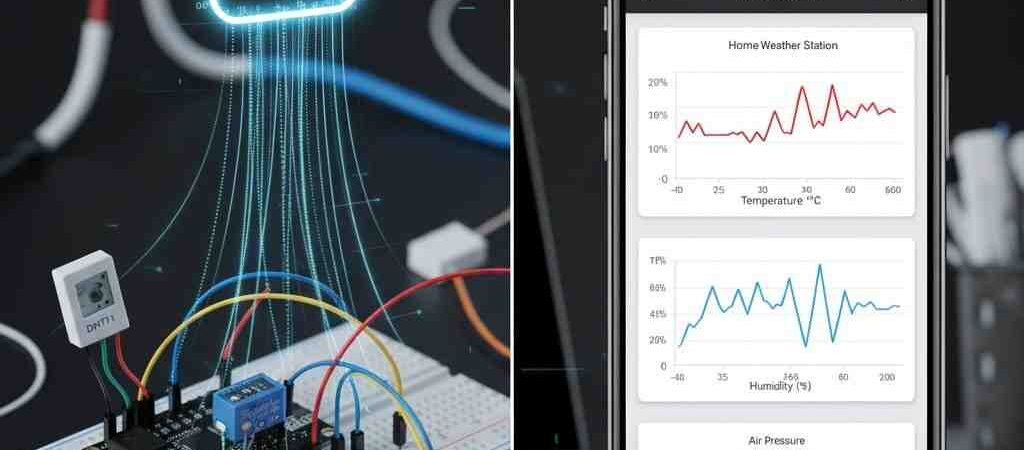
Imagine a temperature sensor installed in a room. The sensor continuously measures temperature and sends data to a cloud platform through an ESP32. Users can view the temperature from anywhere using their smartphone.
This is a simple IoT application.
What is Automation?
Automation refers to the use of technology, control systems, and machines to perform tasks automatically with minimal human intervention.
Automation systems are designed to improve efficiency, consistency, and productivity.
Automation can be found in:
- Manufacturing industries
- Water treatment plants
- Packaging systems
- Traffic control systems
- Home automation systems
- Agricultural equipment
Automation systems often use:
- PLCs (Programmable Logic Controllers)
- Sensors
- Actuators
- Relays
- Motor drives
- Industrial robots
Simple Example
A water tank automation system uses level sensors to monitor water levels. When the level drops below a certain point, a pump automatically starts. Once the tank is full, the pump stops automatically.
This process occurs without human intervention.
How IoT and Automation Work Together
Although IoT and automation are different technologies, they complement each other perfectly.
Automation performs actions automatically, while IoT provides connectivity and remote access.
Example
In a smart irrigation system:
- Soil moisture sensors monitor soil conditions.
- An ESP32 collects sensor data.
- Data is sent to a cloud platform.
- The system automatically turns irrigation pumps on or off.
- Farmers can monitor everything remotely using a smartphone.
This combination creates a powerful and intelligent system.
Key Components of an IoT and Automation System
Sensors
Sensors collect real-world data such as:
- Temperature
- Humidity
- Pressure
- Distance
- Motion
- Water level
Sensors act as the eyes and ears of the system.
Controllers
Controllers process information and make decisions.
Popular controllers include:
- ESP32
- ESP8266
- Arduino
- Raspberry Pi
- PLCs
These devices receive sensor data and execute programmed logic.
Communication Networks
Communication technologies allow devices to exchange information.
Common communication methods include:
- Wi-Fi
- Bluetooth
- Zigbee
- LoRa
- GSM
- Ethernet
These networks connect devices to cloud platforms and users.
Cloud Platforms
Cloud services store and analyze data.
Popular platforms include:
- Google Cloud
- AWS IoT
- Microsoft Azure IoT
- ThingsBoard
- Blynk
Cloud platforms enable remote monitoring and analytics.
Actuators
Actuators perform physical actions.
Examples include:
- Motors
- Pumps
- Solenoid valves
- Relays
- Servo motors
Actuators transform digital commands into real-world actions.
Benefits of IoT and Automation
Increased Efficiency
Automated systems perform tasks faster and more accurately than manual operations.
Reduced Human Error
Automation minimizes mistakes caused by fatigue and inconsistency.
Real-Time Monitoring
Users can monitor systems and equipment from anywhere.
Cost Savings
Businesses reduce labor costs, energy consumption, and maintenance expenses.
Improved Safety
Dangerous tasks can be automated, reducing risks to workers.
Better Decision-Making
Real-time data enables managers to make informed decisions quickly.
Applications of IoT and Automation
Smart Homes
Smart home systems allow users to control:
- Lights
- Fans
- Air conditioners
- Security cameras
- Door locks
through smartphones or voice assistants.
Industrial Automation
Factories use automation and IoT for:
- Production monitoring
- Machine control
- Predictive maintenance
- Energy management
- Quality control
This combination forms the foundation of Industry 4.0.
Smart Agriculture
Farmers use IoT and automation to:
- Monitor soil moisture
- Control irrigation systems
- Track livestock
- Measure weather conditions
This improves crop yields and reduces water consumption.
Healthcare
IoT devices help healthcare providers monitor:
- Heart rate
- Blood pressure
- Oxygen levels
- Patient activity
Remote monitoring improves patient care and response times.
Smart Cities
Modern cities use IoT and automation for:
- Traffic management
- Smart street lighting
- Waste management
- Environmental monitoring
- Public safety systems
These technologies improve urban living and resource management.
Popular IoT and Automation Technologies
Some of the most popular technologies used today include:
- ESP32
- ESP8266
- Arduino
- Raspberry Pi
- PLC Systems
- SCADA Systems
- MQTT Protocol
- Node-RED
- Blynk
- Home Assistant
These tools help developers create powerful connected systems.
Challenges of IoT and Automation
Despite their advantages, some challenges remain.
Security Concerns
Connected devices can become targets for cyberattacks if not properly secured.
Internet Dependency
Many IoT systems require reliable internet connectivity.
Initial Investment
Industrial automation systems can require significant upfront investment.
Data Privacy
Large amounts of collected data must be protected and managed responsibly.
Future Trends in IoT and Automation
The future of IoT and automation is incredibly promising.
Emerging trends include:
- Artificial Intelligence Integration
- Edge Computing
- Digital Twins
- Smart Factories
- Autonomous Robots
- 5G Connectivity
- Predictive Maintenance
- Industry 4.0 Technologies
These innovations will create smarter, faster, and more efficient systems across industries.
Why Students Should Learn IoT and Automation
IoT and automation skills are highly valuable in today’s job market.
Learning these technologies provides opportunities in:
- Industrial Automation
- Embedded Systems
- Robotics
- Artificial Intelligence
- Smart Manufacturing
- Smart Agriculture
- Home Automation
Students who develop practical skills using platforms such as ESP32, Arduino, Raspberry Pi, and PLCs can build exciting projects and pursue rewarding careers.
Conclusion
The world of IoT and automation is transforming industries, homes, and cities. By combining intelligent sensors, connected devices, automation systems, and cloud technologies, organizations can achieve greater efficiency, productivity, and innovation.
Whether it is a smart home, an automated factory, or a connected agricultural system, IoT and automation are driving the next generation of technological advancement. Understanding these technologies today will help individuals and businesses prepare for a smarter and more connected future.
As IoT and automation continue to evolve, the opportunities for innovation are virtually limitless.