As industries continue to adopt smart technologies, two terms are frequently discussed: Industrial Automation and the Internet of Things (IoT). Many beginners, students, and even professionals often confuse these concepts because both involve machines, sensors, controllers, and data communication.
However, Industrial Automation and IoT serve different purposes and are built on different principles.
In this article, we will explore the difference between Industrial Automation and IoT, their working principles, advantages, applications, and how they work together in modern smart factories.
What is Industrial Automation?
Industrial Automation is the use of control systems, machinery, software, and instruments to operate industrial processes with minimal human intervention.
The primary goal of industrial automation is to increase productivity, improve accuracy, enhance safety, and reduce operational costs.
Industrial automation systems typically include:
- PLCs (Programmable Logic Controllers)
- HMIs (Human Machine Interfaces)
- SCADA Systems
- Industrial Sensors
- Variable Frequency Drives (VFDs)
- Servo Motors
- Industrial Robots
Example
A conveyor belt controlled by a PLC that automatically sorts products based on sensor inputs is an example of industrial automation.
The system performs its task without requiring continuous human control.
What is the Internet of Things (IoT)?
The Internet of Things (IoT) refers to a network of physical devices connected to the internet that collect, exchange, and analyze data.
IoT enables remote monitoring, control, and data analytics from anywhere in the world.
Common IoT devices include:
- Smart Sensors
- ESP32 and ESP8266 Modules
- Raspberry Pi
- Smart Meters
- GPS Trackers
- Connected Home Appliances
Example
A temperature sensor connected to an ESP32 that sends live data to a cloud dashboard is an IoT application.
Users can monitor temperature from a smartphone or computer remotely.
Industrial Automation vs IoT: Quick Comparison
| Feature | Industrial Automation | Internet of Things (IoT) |
| Primary Goal | Automatic process control | Data collection and connectivity |
| Connectivity | Usually local networks | Internet-based |
| Response Time | Real-time and deterministic | May have internet latency |
| Controllers | PLCs, DCS, SCADA | ESP32, Raspberry Pi, Cloud Platforms |
| Reliability | Extremely high | Depends on network availability |
| Remote Access | Limited | Excellent |
| Data Analytics | Basic to moderate | Advanced |
| Cost | Higher | Usually lower |
| Main Focus | Control | Monitoring and Connectivity |
How Industrial Automation Works
Industrial automation follows a simple process:
- Sensors detect process conditions.
- PLC receives sensor signals.
- PLC executes programmed logic.
- Output devices are activated.
- Process continues automatically.
Example
In a water treatment plant:
- Level sensor measures water level.
- PLC receives level data.
- PLC starts pump when level is low.
- PLC stops pump when tank is full.
Everything happens automatically and in real time.
How IoT Works
An IoT system typically follows these steps:
- Sensor collects data.
- Microcontroller processes data.
- Data is sent to the cloud.
- Cloud stores and analyzes data.
- User views information remotely.
Example
A warehouse temperature monitoring system:
- ESP32 reads temperature.
- Data is uploaded to the cloud.
- Manager views temperature on mobile phone.
- Alerts are generated if limits are exceeded.
Major Differences Between Industrial Automation and IoT
1. Purpose
Industrial automation focuses on controlling machines and processes.
IoT focuses on collecting and sharing information.
2. Internet Dependency
Industrial automation can operate without internet connectivity.
IoT generally requires internet access for full functionality.
3. Speed
Industrial automation systems respond within milliseconds.
IoT systems may experience delays due to network communication.
4. Reliability
Industrial automation systems are designed for continuous operation in harsh industrial environments.
IoT systems depend on network infrastructure and cloud services.
5. Data Handling
Industrial automation primarily uses data for immediate process control.
IoT uses data for monitoring, analysis, prediction, and optimization.
Advantages of Industrial Automation
Increased Productivity
Machines can operate continuously without fatigue.
Improved Quality
Automation reduces human errors.
Enhanced Safety
Dangerous tasks can be performed automatically.
Reduced Operating Costs
Lower labor requirements and fewer mistakes.
Consistent Performance
Processes remain stable and repeatable.
Advantages of IoT
Remote Monitoring
Equipment can be monitored from anywhere.
Real-Time Data Access
Users receive instant updates.
Predictive Maintenance
Failures can be predicted before breakdowns occur.
Better Decision Making
Data analytics improves operational efficiency.
Scalability
New devices can be added easily.
Industrial Automation Applications
Industrial automation is widely used in:
- Manufacturing Plants
- Food Processing Industries
- Oil and Gas Facilities
- Chemical Plants
- Pharmaceutical Industries
- Water Treatment Plants
- Packaging Systems
- Power Generation Facilities
IoT Applications
IoT is used in:
- Smart Homes
- Smart Agriculture
- Smart Cities
- Vehicle Tracking Systems
- Environmental Monitoring
- Energy Management
- Healthcare Devices
- Remote Asset Monitoring
Can Industrial Automation and IoT Work Together?
Yes.
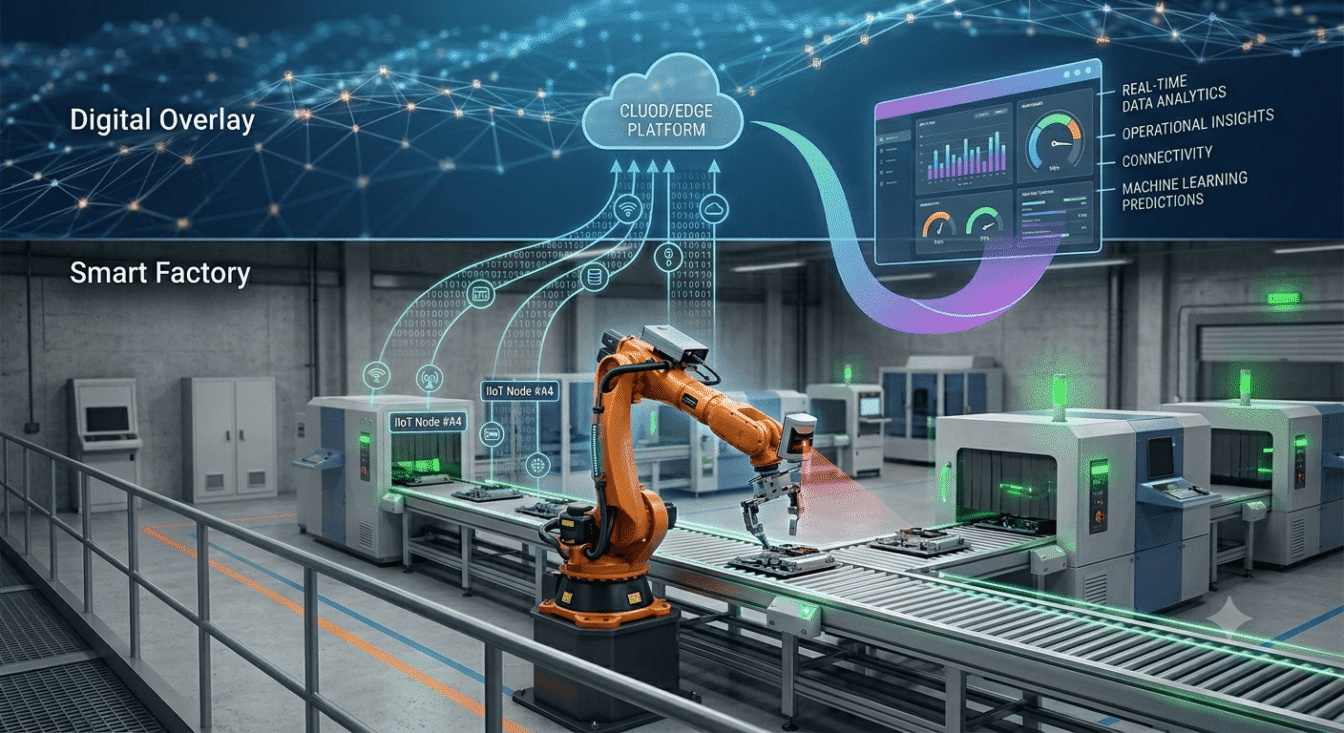
Modern factories increasingly combine industrial automation with IoT technologies.
This integration is commonly called Industrial IoT (IIoT).
Example
A PLC controls production equipment while an IoT gateway sends operational data to the cloud.
Benefits include:
- Remote monitoring
- Predictive maintenance
- Energy optimization
- Production analytics
- Reduced downtime
This combination creates smarter and more efficient industrial systems.
What is Industrial IoT (IIoT)?
Industrial Internet of Things (IIoT) combines traditional industrial automation with internet-connected devices.
IIoT allows industrial equipment to communicate, share data, and support advanced analytics.
Key technologies include:
- PLCs
- SCADA
- Industrial Sensors
- Cloud Platforms
- Edge Computing
- Artificial Intelligence
IIoT is considered a major component of Industry 4.0.
Which One Should You Learn First?
For students and beginners:
Learn Industrial Automation First If:
- You want a career in factories.
- You are interested in PLCs and SCADA.
- You want to work in manufacturing industries.
Learn IoT First If:
- You enjoy electronics and programming.
- You want to build smart devices.
- You are interested in cloud technologies.
Best Approach
Learn both.
Industrial automation provides strong control-system knowledge, while IoT adds connectivity and data intelligence.
Together they offer excellent career opportunities in modern industry.
Future of Industrial Automation and IoT
The future of industry lies in integrating automation, IoT, artificial intelligence, and cloud computing.
Emerging technologies include:
- AI-powered predictive maintenance
- Digital Twins
- Edge Computing
- Smart Factories
- Autonomous Robots
- Industry 4.0 Systems
Organizations adopting these technologies gain higher productivity, lower costs, and better operational visibility.
Conclusion
Industrial Automation and the Internet of Things are closely related but fundamentally different technologies.
Industrial automation focuses on controlling industrial processes efficiently and reliably. IoT focuses on connecting devices, collecting data, and enabling remote monitoring and analytics.
Rather than competing technologies, they complement each other. Modern smart factories combine automation systems with IoT platforms to create intelligent, connected, and highly efficient operations.
Understanding both technologies is essential for engineers, technicians, students, and businesses preparing for the future of Industry 4.0.